|
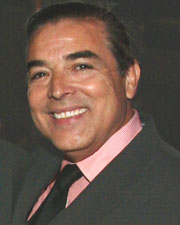
Gabriel
Reyes
January 15, 2007
Gabriel
Reyes took a circuitous route to found 10 years ago this month
his Hollywood, Calif.-based PR agency Reyes Entertainment. He
started out as an actor but found his true calling in PR and
marketing after a disastrous
meeting with a
casting agent back in the '80s.
“I remember having an epiphany one day,” he
recalled. “These casting directors sit in a room all day with
a camera and see 200 to 300 guys for a 30-second commercial. I
walked in and I realized that, as I was doing my audition, the
casting director wasn’t even looking at me. She was having her
lunch. I think that the issue is that American mainstream
media doesn’t have any idea of who Hispanics really are.
Hispanics ourselves have an image problem. So I thought that
the way to do this is for me to get some kind of career in
communications, so that I’m able to work on behalf of
Hispanics.”
That was then. Today
Reyes is doing his part to “unmarginalize” Latinos working in
Hollywood and share their accomplishments with both Spanish-
and English-language media. He counts among his clients ABC,
CBS daytime, Warner Home Video and Univision’s Cristina
Saralegui.
Reyes, who was born in
Mexico but moved to Texas when he was 12, took time to discuss
his entry into Hispanic entertainment PR and marketing
with Marketing y Medios’ Nancy Ayala, before serving on
a panel during this week’s NATPE (National Association of
Television Program Executives) conference in Las Vegas.
Q: Who was your first
client?
A: I started working with
Nely Galán [of The Swan producing fame] called ProPix.
We had a deal at HBO. The company’s mandate was to begin
producing Latino entertainment in English for American
Latinos. I don’t think HBO Latino was even launched yet. It
was so early on, we’re talking early ’90s, that the term
Latino market wasn’t even in play yet. People still had the
idea that it was all Univision and Telemundo, and that if you
were Hispanic, why would you want to watch Latinos on American
television? That’s the kind of stuff that I would get all the
time. But HBO had the vision to create programming for Latinos
in English. And I thought, I’ve died and gone to heaven in
working with [Galán]. At first I was her development
executive, I was reading all these scripts and meeting with
talent and directors, etc. etc. But at the same time, I was
putting together pitch letters to local newspapers and local
television stations telling them what we were doing. It was a
very novel thing at that time, and most people didn’t get
that.
Q: Most probably
didn’t know who Nely was at that time.
A: When I met
her, she was launching the Fox Latin American channel. She
wasn’t really on the map. I really started banging the drum
about how we felt very strongly that English-speaking Latinos
were being completely ignored by media in the United States,
and we were expected to consume media coming from Latin
America, especially television coming from Latin America, even
though we didn’t feel like any of that spoke to us. We were
really hungry to develop and see images of ourselves living in
the U.S. and our experience in the U.S. That was really
unheard of way back then. One of the shows that we did manage
to produce was Loco Slam, which was a Latino comedy
special that was executive-produced by Paul Rodriguez. Carlos
Mencia was in that show with a bunch of other Latino comedians
who have gone on to bigger and better things. I started to put
Nely on the map in terms of public relations and marketing
[with articles in] USA Today, Los Angeles Times, The New
York Times Magazine. That was around 1993-1994. It kind of
went up after that. Very soon after that, we were able to get
a bigger deal with Fox Television, and that’s when Nely
reconstituted the company and called it Galán Entertainment. I
became her director of creative affairs at that time, handling
a mix of development and PR and marketing. That’s when people
started to notice who was behind some of these efforts. I
started to get calls from people saying, “I love what you’re
doing with Nely. Can you do that for me?”
Q: And you’re still working with
Nely?
A: Yes. Even after all these
years, she’s still my client, which is a rarity these days.
Nely was very supportive when I told her I wanted to strike
out on my own.
Q: Who
were some of your other earlier clients?
A: I got Latina magazine [in 1995].
One of the big coups was when they were trying to figure out
who should be on the cover of the first issue. I spoke to
[then editor] Christy [Haubegger], and I said, “I think you
should put this woman named Jennifer Lopez on the cover. She
has Blood and Wine coming up, she has a new movie
called The Money Train. She was in My Family/Mi
Familia, which was her very first film. I said, “I think
she’s very talented, and I think she’s going to be very big.”
So we put her on the cover, and it was her very first cover
and her first in-depth story in any magazine, and lo and
behold, as the magazine came out in May of ’96, that’s when it
was announced that she was cast as Selena [in the same-name
movie]. It was perfect because right as the magazine came out,
there was a press conference announcing Jennifer Lopez as
Selena, so I passed out a lot of the magazines there at the
press conference. Nobody really had an in-depth story on
Jennifer except us. So that was a great first step there. I
remained with Latina magazine as its publicist for the
next five years, and I still had my own company. I also began
to work with the studios and networks. What I felt was before
then we were a marginalized market. That is to say, everybody
thought we were all in Spanish, and there were these two
parallel worlds existing side by side, and never kind of
meeting. To this day, I think there’s some of that still left
with the whole Spanish-language world. Sometimes mainstream
media has no idea. My idea was that I was going to build a
company that was going to pull down those barriers, to say
that it doesn’t matter what language you speak, we are Latinos
living in the United States. Some of us speak English, some of
us speak Spanish, most of us speak both, and we deserve to be
in mainstream media.
Q:
It sounds like your business model started as informing the
general-market about Latino entertainment personalities, but
you also deal with Spanish-language media. Please explain how
you work with both.
A: Because I
felt like I would have no limits, I would have no barriers, I
began to be an expert in both English- and Spanish-language
media. Some of my clients originated in the Latino space, but
they wanted to be promoted in mainstream, so I did that. Some
of my clients originated in mainstream space and wanted to be
promoted in Hispanic space. I’ve been going back and forth
between those two worlds. And the whole idea was, why not? If
you’re looking for consumers for your show or project, why
would you market in only one market, why not do both?
Q: Is it equally difficult
to convince Spanish media that it should be covering what a
Latino actor is working on in the mainstream, be it television
or film or some other medium?
A:
Sometimes it is difficult, but if it’s something that’s
palatable for their consumers, they will do it. More and more,
they’re apt to do it because Spanish-language media does pay
attention to what’s going on in Hollywood. They regularly
cover it. But there is some resistance in some quarters, based
on who it is, what the project is, or whether it conflicts
with what their parent media company is. I’ve always been very
creative in terms of how to get the more ink and the most
notoriety for my clients and still keep all my relationships
intact.
Q: Sounds like
you’ve seen the entire gamut as entertainment marketing has
evolved, as both markets are covering the same thing.
A: More and more, that’s happening. By
virtue of everything that’s been going on. It’s not only the
unprecedented growth of our population and the spending power,
and the fact that we are moving into positions of power and
importance within mainstream U.S. Mainstream corporate America
has begun to realize that there’s this whole other demographic
here. Contrary to popular belief, Hispanics do have money to
spend and do outspend other groups in a lot of different
categories. Once all that information started to come out,
then it really became a snowball effect. Many companies and
corporations very actively began to pursue this other market
and began to integrate their outreach into their overall
plan.
Q: That brings us
to some of your current clients. You’ve worked with ABC for a
long time, more so in the last year.
A:ABC is the one that I’ve put a lot of time
in, not only Ugly Betty, which is one of the breakout
hits, but I’ve been working with George Lopez since its
inception back in 2002. We’re going into a sixth season now,
and George Lopez is going into syndication. We’ve
played a big role in the success that, that show has had, and
one of the groundbreaking shows in terms of Latino images on
mainstream television. We work with Ugly Betty, Desperate
Housewives; we work with Lost. It’s been wonderful
because ABC itself has done such a great job at including
Hispanics at all levels in their shows. Most of their shows
has at least one Hispanic in them, and I have to say that is a
great asset in order to build viewership of Hispanics who
maybe before weren’t tuning into ABC programming.
Q: Do you still work with
any Hispanic media groups, print or television?
A: I worked with [English-language Latino
youth cable network] Sí TV several times when it launched and
[then again] about a year and a half ago. I did work with
Telemundo when Nely was president of entertainment. Of course,
I work with Cristina Saralegui. So, yes, I do work with
Spanish-language properties.
Q: What’s it like working with Cristina,
and what does that entail?
A: With
Cristina I feel such closeness to her because not only is she
a wonderful role model, but she’s an exceptional person
herself. Her husband, Marcos, and their family are very kind
and very generous and exceptional in what they do. They make
my job very easy, because it’s kind of a friendship situation
where we can talk on the phone and talk like friends and then
talk about work and what it is that we need to do. When we go
to events, it’s kind of like a family gathering. You kind of
get together, you have a couple of drinks, you do your work,
you go out to dinner afterwards. They’re always interested in
having fun in what they do. I think that’s a great thing for
me because I’m so focused on work that sometimes I forget to
have fun. Now that she’s branched out into other areas besides
her television show, there’s more of an opportunity to promote
her in her different facets, not only in Spanish [on the
entertainment side] but also in English. I’m doing a lot in
terms of her furniture collection [Casa Cristina].
Q: On Jan. 18, you’ll be
part of a panel at NATPE called “Si Hablo English! Do You Want
My Eyeballs and My Money?” What do you hope to impart during
the conference?
A: It’s very
apropos, and it’s very timely for this convention to be
hearing about the developments going on in the Hispanic world,
especially vis-à-vis the younger generation that speaks
English and consumes media in English since that still seems
to be a novelty for a lot of people. I’m excited to impart
some strategies and ideas about this market.
Q: I remember you mentioned some time ago
that your aspiration was to become an actor yourself. What
happened?
A: Yes, I started out as
an actor, and actually lived in New York throughout the 1980s
after graduating from The University of Texas with a degree in
acting and directing. I was lucky enough to get work and
immediately join the Screen Actors Guild and AFTRA, the
American Federation of Television & Radio Artists, as well
as Actors’ Equity Association for stage plays. So I was very
lucky to be able to get into the union right away and began to
work in commercials. I did a couple of small film roles such
as in The Believers, with Jimmy Smits, if you can
believe that, and Martin Sheen. I was in a bunch of soap
operas. But what I began to realize was how stereotypical
Hispanic roles were, I was either playing the waiter or the
South American revolutionary. So I started to think for myself
that I wanted to fulfill more potential that I had, and it
wasn’t really happening on the acting side, not that I didn’t
love the craft of acting, but there was a lot of frustration
in the actual going to look for work. At that time, being a
Hispanic was really a liability. If you had a Hispanic surname
or you looked Hispanic, casting directors wouldn’t touch you,
because you were just not going to get cast in any American
project unless it specifically asked for Hispanic. … The idea
that I was going to go into PR wasn’t jelled yet, but I really
thought that I had to get into some kind of communications and
promotion career that would help me to do this.
Q: After 10 years, what’s
the next step?
A: The next step for
me is to continue the work that I’ve been doing, and obviously
grow my business and also to begin to look at myself as a
producer of projects. I need to look at other great
opportunities to continue in this wave of Latino projects, and
see how I can work myself in behind the camera on some of
these other projects.
|
Copyright 2005 Marketing y
Medios | |
|
 |